
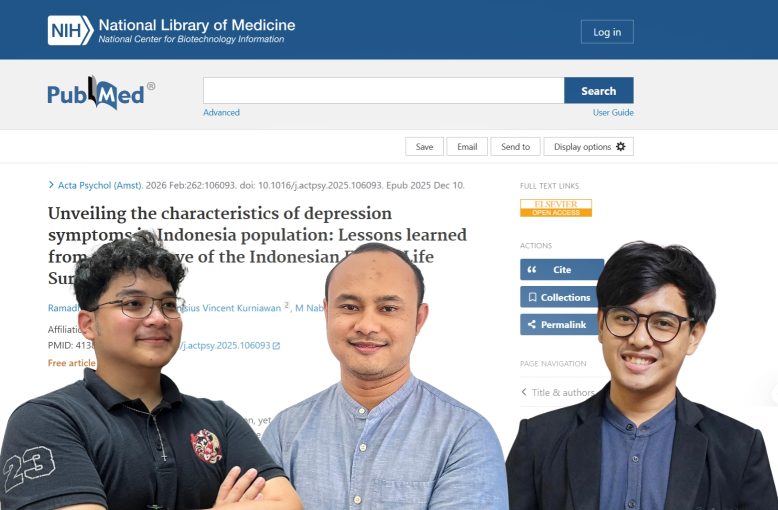
Dionisius Vincent Kurniawan, a student from the International Undergraduate Programme (IUP) of the Faculty of Psychology at Universitas Gadjah Mada, batch of 2023, has recently co-authored a research paper that has been published in an international journal. The study was conducted in collaboration with Ramadhan Dwi Marvianto, S.Psi., M.A., and Muhammad Nabhan Husein, S.Psi., M.Psi., Psikolog, both researchers from the Faculty of Psychology UGM.
The research focuses on the heterogeneity of depressive symptom profiles among individuals in Indonesia, using data from the Indonesia Family Life Survey (IFLS-5). One of the most significant findings of the study was that individuals who fell into the moderate and severe-risk depressive symptom classes still showed relatively high probabilities of endorsing feelings of hope and happiness. This is noteworthy because depression is traditionally associated with a complete absence of positive emotions. The findings suggest that depressive symptoms in Indonesia may not always manifest in the way that is commonly expected.
To interpret this finding, the research team explored existing literature on culture and emotional expression. One possible explanation is that collectivist values and religiosity, which are deeply embedded in Indonesian society, may influence how individuals express and cope with difficult emotions. These cultural factors may allow people to maintain a sense of hopefulness even while experiencing significant depressive symptoms. The team acknowledges, however, that this remains an interpretation, as religiosity and cultural variables were not directly tested in this particular study.
The idea for the research was initially brought forward by Mas Marvianto, who approached Doni with the topic. Each member of the team contributed according to their strengths: Mas Marvianto handled the measurement and statistical aspects of the study, particularly regarding the psychometric properties of the CES-D-10 scale used in the IFLS-5 data. Doni focused on reviewing the analyses and constructing the discussion section, connecting the findings to existing literature. Meanwhile, Mas Nabhan refined the writing to ensure the paper was cohesive and readable.
The process was not without its difficulties. One of the most challenging aspects was interpreting findings that did not align with conventional expectations, particularly those related to marital status, sex, and positive affect among individuals with depressive symptoms. The peer review process also required considerable effort, as the work was evaluated by experienced researchers in the field. Despite these challenges, the team successfully saw the paper through to publication.
Beyond its academic contribution, the research carries meaningful implications for the general public. On one hand, the findings offer a sense of hope, demonstrating that experiencing depressive symptoms does not necessarily mean the complete loss of happiness or hopefulness. On the other hand, the findings also serve as an important reminder not to judge someone’s mental health based on surface-level appearances alone, as a person may appear happy and hopeful while simultaneously experiencing severe depressive symptoms.
Looking ahead, Doni plans to continue exploring this line of inquiry in his thesis, with a focus on how religiosity and positive and negative affect may relate to depressive symptoms across different religious backgrounds in Indonesia. For fellow students who are considering getting involved in research, Doni encourages them not to wait until they feel fully prepared. According to him, curiosity is enough to get started, and opportunities are best sought by reaching out to lecturers and researchers who can offer guidance and experience.
Writer: Thessalonica Faith Hill Joseph Kurnia