Raden Adjeng Kartini was born on 21 April 1879 in Jepara, Central Java. She was the fifth child of Raden Mas Adipati Ario Sosroningrat, a Javanese regent, and his second wife, M.A. Ngasirah. Growing up in a noble household meant that Kartini had access to something most girls in her era did not: a formal education. She attended a Dutch-language primary school, where she quickly proved herself to be a bright and enthusiastic student. She was fluent in Dutch, loved reading, and dreamed of continuing her studies.
SDG 4: Quality Education
International Women’s Day is a special moment to celebrate the achievements of women, reflect on the challenges they face, and recognize the importance of solidarity and support among women. On university campuses, these bonds of sisterhood are especially meaningful. At the Faculty of Psychology in Universitas Gadjah Mada, female students significantly outnumber male students, creating an environment where friendships among women become a vital source of support, understanding, and empowerment.
The International Undergraduate Program (IUP) of the Psychology Faculty at Universitas Gadjah Mada successfully conducted its first intake selection process, attracting strong interest from prospective students who aspire to pursue psychology in an international academic environment. A total of 112 applicants registered for this intake, reflecting the growing recognition of IUP Psychology UGM as a program that prepares students for global academic and professional engagement.
The Graduation Ceremony Period II 2026 became an unforgettable moment for Asma Ningrum Abdurrahman, who was awarded the Best IUP Student Publication Manuscript. When her name was announced, she was genuinely surprised. She shared that she did not expect it at all, especially knowing that many of her peers had also produced outstanding theses. For Asma, the recognition feels both humbling and meaningful. She hopes her work can now reach more readers and help raise awareness of political psychology, a field she believes is still underdiscussed despite its relevance to today’s political climate.
Heavy rainfall in November 2025 triggered widespread floods and landslides across Aceh Province, affecting thousands of families. Schools were suspended, infrastructure was damaged, and access to clean water and healthcare became limited. Beyond the physical destruction, the disaster also left significant psychological and social impacts on communities.
Disaster Response and Field Experience
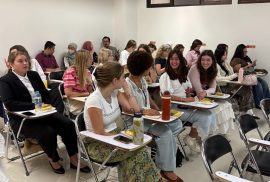
During the lecture, Al Fadhil shared firsthand experiences from emergency response efforts, including distributing food, clean water, and medicine to isolated areas such as Aceh Tamiang. With damaged roads and limited access, some aid had to be delivered by sea before continuing by land. Power outages, weak communication networks, and limited health facilities made the situation even more challenging.
The session also introduced the cluster approach in disaster management, where sectors such as shelter, health, water and sanitation, protection, and psychosocial support coordinate under a structured system. Students learned that effective humanitarian response relies on collaboration between government institutions, non-governmental organizations, and community actors.
Rapid needs assessment was another key topic. By combining interviews with local leaders, health workers, and vulnerable groups with field observations and official reports, humanitarian teams can identify urgent priorities such as clean water, medical services, shelter, and psychosocial support.
Integrating Mobile Clinics and Psychoeducation
A highlight of the lecture was the integration of mobile health services with structured psychoeducation programmes. The mobile clinic model brings essential healthcare directly to evacuation sites and remote villages. Services include medical consultations, treatment of common illnesses, maternal and child health care, and distribution of essential medicines. By reducing access barriers, the programme ensures timely and equitable care.
Alongside medical services, psychoeducation sessions are conducted for children, women, and caregivers. These sessions focus on understanding stress reactions, coping with trauma, parenting during crisis situations, and practicing self-care. Safe spaces and child-friendly activities help restore a sense of safety and normalcy, especially for children who are particularly vulnerable to psychological distress.
For students of Community Empowerment and Psychoeducation, the lecture served as a reminder that empowerment is about providing material assistance, strengthening resilience, and upholding human dignity. By connecting classroom concepts with real humanitarian practice, the session helped deepen students’ understanding of the important role psychology plays in disaster response and community recovery.
Writer: Thessalonica Faith Hill Joseph Kurnia