
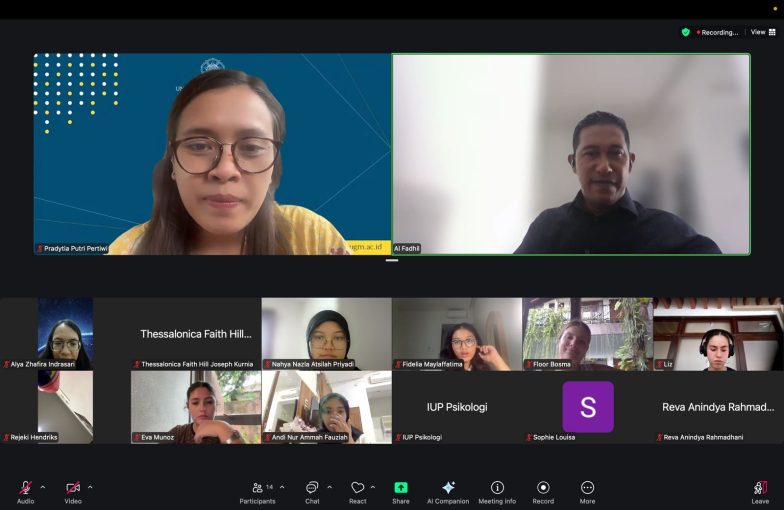
On 19 February 2026, students of the course Community Empowerment and Psychoeducation attended a guest lecture delivered by Al Fadhil, Director of Geutanyoe Foundation, a humanitarian organization actively involved in disaster response and community-based recovery programmes. Titled “Understanding and Addressing Needs: Mobile Clinic and Psychoeducation Programmes for Aceh Flood Survivors,” the session brought real humanitarian field experience into the classroom and connected theory with practice in disaster settings.
Heavy rainfall in November 2025 triggered widespread floods and landslides across Aceh Province, affecting thousands of families. Schools were suspended, infrastructure was damaged, and access to clean water and healthcare became limited. Beyond the physical destruction, the disaster also left significant psychological and social impacts on communities.
Disaster Response and Field Experience
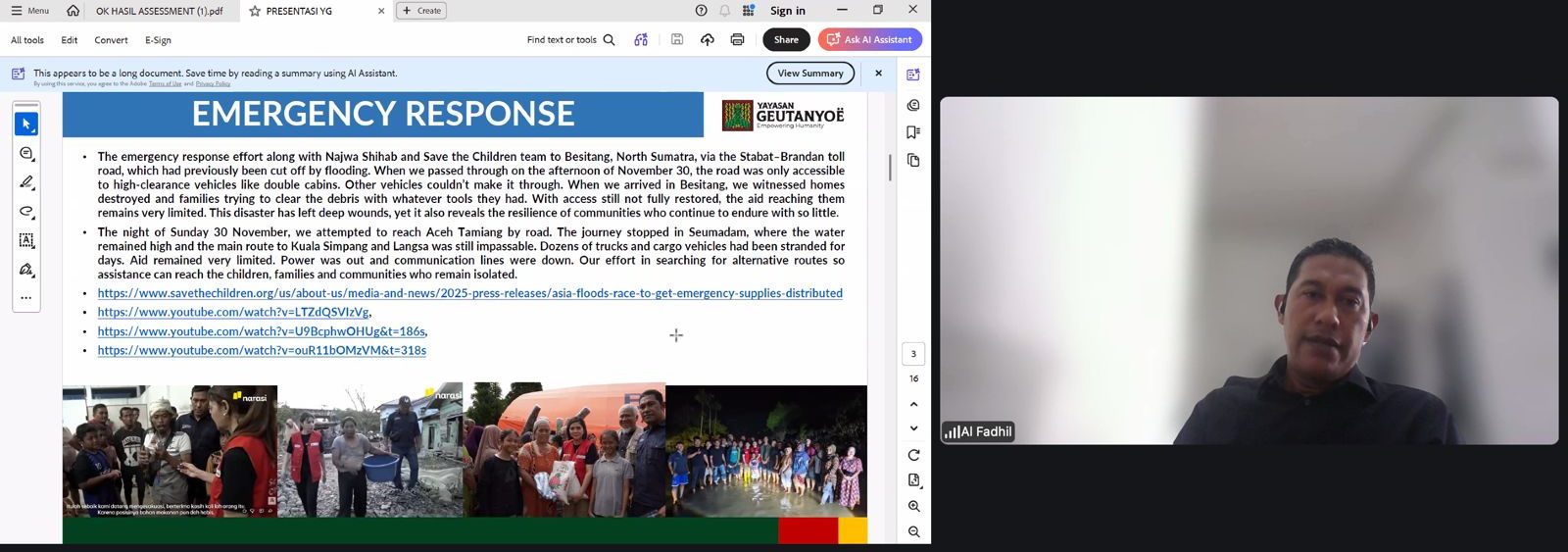
During the lecture, Al Fadhil shared firsthand experiences from emergency response efforts, including distributing food, clean water, and medicine to isolated areas such as Aceh Tamiang. With damaged roads and limited access, some aid had to be delivered by sea before continuing by land. Power outages, weak communication networks, and limited health facilities made the situation even more challenging.
The session also introduced the cluster approach in disaster management, where sectors such as shelter, health, water and sanitation, protection, and psychosocial support coordinate under a structured system. Students learned that effective humanitarian response relies on collaboration between government institutions, non-governmental organizations, and community actors.
Rapid needs assessment was another key topic. By combining interviews with local leaders, health workers, and vulnerable groups with field observations and official reports, humanitarian teams can identify urgent priorities such as clean water, medical services, shelter, and psychosocial support.
Integrating Mobile Clinics and Psychoeducation
A highlight of the lecture was the integration of mobile health services with structured psychoeducation programmes. The mobile clinic model brings essential healthcare directly to evacuation sites and remote villages. Services include medical consultations, treatment of common illnesses, maternal and child health care, and distribution of essential medicines. By reducing access barriers, the programme ensures timely and equitable care.
Alongside medical services, psychoeducation sessions are conducted for children, women, and caregivers. These sessions focus on understanding stress reactions, coping with trauma, parenting during crisis situations, and practicing self-care. Safe spaces and child-friendly activities help restore a sense of safety and normalcy, especially for children who are particularly vulnerable to psychological distress.
For students of Community Empowerment and Psychoeducation, the lecture served as a reminder that empowerment is about providing material assistance, strengthening resilience, and upholding human dignity. By connecting classroom concepts with real humanitarian practice, the session helped deepen students’ understanding of the important role psychology plays in disaster response and community recovery.
Writer: Thessalonica Faith Hill Joseph Kurnia